Procurement Fraud Rarely Starts with an Envelope of Cash
How relationships, hospitality and small exceptions can grow into bribery, bid manipulation and false billing
The first conversation is rarely the corrupt one
When people imagine procurement fraud, they often picture a supplier sliding an envelope of cash across a table. That can happen, but it is seldom how a corrupt relationship begins. Few successful frauds start with the villain clearing his throat and announcing the criminal proposal. An explicit bribe creates an immediate risk of rejection, exposure and prosecution. A supplier who wants influence is more likely to begin with something socially acceptable: lunch, a sporting event, a conference dinner, a strip club, a favour or a round of golf.
Golf is particularly effective because the green fee is not necessarily the main benefit. The supplier has the buyer’s ear for four hours, often on a recurring basis, away from the office and formal scrutiny. Eighteen holes is an unusually generous meeting slot, particularly when nobody is taking minutes. Over time, conversation moves from business to family, frustrations, ambitions and personal pressures. A commercial contact becomes a friend. Once that happens, a request that would look improper in an email may feel like helping someone the buyer knows and trusts.
More compromising entertainment can accelerate the process. An offer of sex is an obvious bribe. A visit to a strip club may be less explicit, although it is rarely listed in the organization’s approved procurement methodology. It can create secrecy, embarrassment or a shared transgression. The supplier learns whether the buyer will cross a boundary and whether the buyer now has something to conceal.
How grooming becomes fraud
The progression is often gradual:
1. Access. The supplier creates legitimate opportunities to spend time with the buyer.
2. Reciprocity. Meals, tickets, travel, golf or personal favours create a sense of obligation. The supplier remembers the buyer’s birthday and, with equal enthusiasm, the tender timetable.
3. Boundary testing. The supplier watches how the buyer responds to an undeclared gift, an off-colour venue or a small policy exception.
4. The first favour. The request is deliberately ambiguous: “Can you tell me whether our price is in the ballpark?” or “Could you make sure we are included?”
5. A shared secret. The benefit and the favour are left unreported. Both parties now have an interest in keeping the relationship quiet.
6. Escalation. Small favours grow into leaked bid information, tailored specifications, false approvals, inflated invoices or kickbacks.
This explains why the first conversation is so difficult to identify. There may never be a sentence such as “I will pay you if you award me the contract.” People engaged in procurement fraud are curiously reluctant to prepare helpful minutes. Instead, the parties create a pattern in which the corrupt understanding becomes obvious to them without ever being stated plainly.
Why the psychology works
The supplier is not necessarily looking for a buyer who arrived at work intending to be corrupt. That would be convenient, but it would also be a rather limited sales strategy. Grooming works because it uses ordinary human tendencies that normally help relationships function: reciprocity, consistency, loyalty, trust and the desire to think well of ourselves. The problem is not that these instincts are abnormal. The problem is that they can be redirected toward an improper purpose.
Reciprocity: the invisible invoice
A meal, ticket or golf invitation does not have to include an express condition. The recipient may create the condition internally. Sociologist Alvin Gouldner described the basic norm succinctly: “people should help those who have helped them.”[1] The supplier therefore need not ask for repayment immediately. Repeated hospitality can leave the buyer feeling that refusing a later request would be ungrateful, disloyal or even rude.
This is why the value of hospitality cannot be measured only by the receipt. A modest benefit delivered repeatedly, or at a moment when the buyer particularly values it, can create more psychological obligation than an expensive one-off gift. The supplier may never send an invoice for the favour. Human nature is often efficient enough to prepare it automatically.
Small commitments change the next decision
Freedman and Fraser’s classic “foot-in-the-door” research examined how agreement to a small request can increase compliance with a larger request later.[2] In procurement, the first request may be harmless or merely questionable: include the supplier on the bid list, explain the timetable or say whether the proposed price is remotely competitive. Once the buyer has helped, the next favour feels less like a new ethical decision and more like a continuation of the existing relationship.
Each step also changes the buyer’s understanding of what is normal. Providing the tender budget would have seemed outrageous on the first meeting. After a year of lunches, golf and smaller disclosures, it can be reframed as helping a trusted supplier avoid wasting everyone’s time. Fraud has not become ethical. It has simply become familiar.
Self-image: dishonest conduct by an “honest” person
Most participants do not wake up and decide to become the corrupt procurement officer in the next training video. They continue to regard themselves as decent people. Research by Mazar, Amir and Ariely found that people can behave “dishonestly enough to profit, but honestly enough to delude themselves of their own integrity.”[3] That gap is where rationalization operates.
The buyer says the supplier would have won anyway, the information was not truly confidential, the entertainment did not influence the decision, or the organization underpays its staff. Language helps. A bribe becomes hospitality; bid leakage becomes market intelligence; favouritism becomes relationship management. The conduct remains the same, but it has been given a more comfortable name.
Moral disengagement: switching off the alarm
Albert Bandura explained that the “selective activation and disengagement of internal control” allows different conduct under the same moral standards.[4] People do not necessarily abandon their values. They temporarily disconnect those values from a particular act by minimizing the harm, shifting responsibility, blaming the system or comparing their conduct with something worse.
A buyer who would reject an envelope of cash may approve a questionable change order while insisting that nobody was harmed because the work was required. A manager may sign a false sole-source justification because procurement rules are “too bureaucratic.” Apparently a control becomes optional once it has been sufficiently annoying.
Habituation and the slippery slope
The first improper act usually produces the most discomfort. If nothing happens, the emotional response fades and the next step becomes easier. Garrett and colleagues found evidence that dishonesty can increase with repetition, concluding that “what begins as small acts of dishonesty can escalate into larger transgressions.”[5]
This gives the supplier a reason to proceed slowly. A request for the competitors’ bids on day one may be refused and reported. A sequence of small exceptions allows the buyer to become accustomed to crossing the line. By the time money changes hands, both parties may see the payment not as the beginning of corruption but as the logical continuation of a relationship they have already spent months concealing.
Loyalty, secrecy and the new in-group
Long periods of informal contact can shift the buyer’s identity. The supplier is no longer an outside bidder but a friend, golfing partner or confidant. The buyer may begin to view internal procurement staff as obstacles and the supplier as part of the same team. Shared secrets strengthen that boundary: reporting the supplier would also expose the buyer’s own undisclosed conduct.
This is one reason compromising entertainment is so effective. It creates more than gratitude. It creates mutual vulnerability. The relationship is held together by friendship, obligation and the knowledge that an honest conversation with compliance would be uncomfortable for everyone involved.
The principal forms of procurement fraud
Procurement fraud can occur before a tender is issued, during bidding, after the contract is awarded or when the invoice is paid. Several schemes often operate together.
1. Bribes, kickbacks and improper benefits
A supplier gives something of value in return for favourable treatment. Cash is only one possibility. Benefits can include entertainment, travel, sexual services, gifts, home improvements, jobs for relatives, sham consulting fees, charitable donations directed by the buyer or future employment. The payment may be made before an award, after payment of invoices or as a percentage of the contract.
The corrupt act may be disguised as ordinary relationship-building. “Relationship-building” is a wonderfully elastic expression: it can describe a cup of coffee or a week in the Caribbean. The relevant questions are not merely who paid for dinner or golf, but whether the benefit was disclosed, whether it was proportionate, whether it was repeated and what procurement events followed.
2. Bid rigging and supplier collusion
Suppliers may agree not to compete honestly. Common arrangements include:
Cover bidding: designated losers submit deliberately high or defective bids so a chosen supplier appears competitive.
Bid suppression: competitors agree not to bid or withdraw their bids.
Bid rotation: suppliers take turns being the successful bidder.
Market allocation: suppliers divide customers, products or geographic areas.
The buyer may be innocent, complicit or wilfully blind. Warning signs include identical wording or errors, bids submitted from the same address, predictable winners, unusual subcontracting among bidders and prices that move together without a commercial explanation.
3. Tailored specifications and false sole sourcing
A procurement employee can draft specifications that only the favoured supplier can meet, impose unnecessary experience requirements or use brand-specific language without justification. The same objective can be achieved by claiming that only one supplier is capable, that compatibility requires a particular vendor or that there is no time for competition.
The tender may look competitive on paper while the result was decided before it was issued. It is competition in much the same way that professional wrestling is unscripted: the audience is encouraged to admire the contest without asking who selected the winner.
4. Leaking confidential information
A favoured bidder may receive the budget, competitors’ pricing, scoring criteria, technical weaknesses or the amount needed to win. Sometimes the information is provided through personal email, messaging applications or casual conversations rather than formal channels. A supplier who consistently wins by a narrow margin deserves closer examination.
5. Splitting purchases to avoid approval limits
A larger purchase is divided into several smaller purchase orders or invoices so each falls below a competitive tender, management approval or board reporting threshold. It is the accounting equivalent of trying to move an elephant through a doorway one shopping bag at a time. The entries may be posted on consecutive days, assigned to related cost centres or described as separate phases of the same work.
6. Phantom vendors and undisclosed related parties
An employee creates a fictitious supplier, uses a dormant company or directs business to a company owned by the employee, a family member or an associate. Creating a vendor can be surprisingly easy; apparently the computer assumes that anyone with a bank account and a convincing name must be respectable. A real supplier may also act as a pass-through, adding a margin without providing meaningful goods or services. Conflicts are often hidden through nominee directors, shared addresses, personal email accounts or payments routed through an intermediary.
7. Inflated, duplicate or fictitious invoices
Once a supplier has access to the payment process, invoices may charge for goods never delivered, hours never worked or quantities beyond those received. The same invoice can be submitted twice with a changed number or date. Prices may exceed the contract, freight may be billed twice, or vague “management” and “consulting” charges may conceal the extraction of funds.
8. Change-order abuse
A supplier submits an attractive low bid and recovers profit through additions after the contract is awarded. Some changes are legitimate. The risk arises when the original scope was deliberately incomplete, work begins before approval, pricing is unsupported or the same buyer repeatedly authorizes changes that eliminate the apparent savings from the tender.
9. Product substitution, short delivery and false acceptance
The supplier delivers inferior materials, fewer units or a lower specification than the contract requires. A complicit employee signs the receiving report or certifies that work was completed. This is especially difficult to detect when the goods are consumed quickly, delivered to remote sites or technically complex.
10. Procurement cards and personal purchases
Corporate cards and online purchasing can bypass normal controls. Personal goods may be described as supplies, receipts may be altered, one purchase may be divided among cards or items may be returned for a personal refund. A supervisor’s approval is of little value if the supervisor receives only a statement and no evidence of business purpose or receipt.
11. Emergency procurement abuse
Emergencies legitimately require speed. They also remove competition and compress review. A dishonest buyer may exaggerate urgency, allow planning failures to create an emergency or continue using emergency procedures long after the immediate need has passed. If the same emergency returns every month and always requires the same supplier, it has ceased to be an emergency and acquired a standing appointment.
12. Contract steering and post-award favouritism
Fraud does not end when the contract is signed. A buyer can overlook missed milestones, waive penalties, approve weak work, extend a contract without competition or direct additional assignments to the incumbent. In return, the buyer may receive benefits now or expect employment with the supplier later.
Where the fraud triangle fits
The traditional fraud triangle identifies pressure, opportunity and rationalization. Procurement relationships can create or strengthen all three.
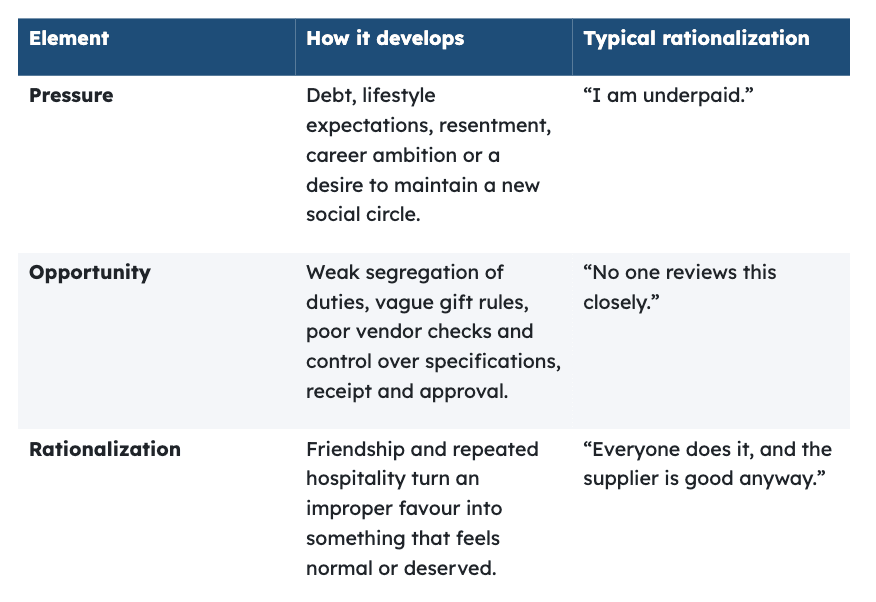
The triangle is not static. A supplier can manufacture opportunity by cultivating private access, encourage rationalization through friendship and identify pressure by listening to the buyer’s complaints. Capability also matters: the person must understand the procurement system, exercise influence and manage the deception.
Red flags worth investigating
No single indicator proves fraud. Even fraudsters are entitled to coincidences; they are simply not entitled to an unlimited supply of them. A pattern of indicators, especially when tied to procurement decisions and unexplained benefits, warrants examination:
- One supplier’s business grows rapidly without an obvious performance or price advantage.
- The buyer has frequent private contact, travel, hospitality or recreational activity with a supplier.
- Gifts and entertainment are not declared, are described vaguely or fall repeatedly just below approval limits.
- Bids contain matching errors, formatting, metadata, addresses or unusual similarities.
- The winning price is consistently just below competitors or the organization’s confidential budget.
- Purchases, contracts or invoices fall just below tender or approval thresholds.
- Sole-source and emergency justifications repeat, use boilerplate wording or involve the same vendor.
- Purchase orders are created after invoices arrive or after work has begun.
- Change orders erase the apparent advantage of the winning bid.
- Vendor banking, addresses, telephone numbers or beneficial owners connect to employees or their families.
- Receiving records are missing, copied or approved by the same person who ordered the goods.
- An employee resists job rotation, mandatory leave, independent contact with suppliers or review of personal communications on company systems.
The investigation must connect the relationship to the decision
Reviewing the general ledger is necessary, but it is not enough. The most persuasive analysis is usually a chronology that places benefits and private contact beside procurement events. Investigators should compare gifts, golf bookings, sporting events, travel, restaurant charges and personal communications with tender dates, bid revisions, approvals, change orders and payments.
The question is not simply whether two people played golf. It is whether undisclosed hospitality created access or obligation, whether confidential information moved between them and whether the buyer took actions that departed from normal practice. The same approach applies to strip clubs, football games, travel and personal favours.
Controls that address the human problem
Policies are useful only when the organization can see and test the relationships around procurement. A gift policy that nobody reads, enforces or checks is not a control. It is office stationery. Effective measures include:
- Clear gift, hospitality and conflict rules, including cumulative annual limits and pre-approval for higher-risk events.
- Disclosure of personal relationships with suppliers and periodic conflict confirmations from buyers and approvers.
- Vendor due diligence that identifies beneficial ownership, related parties, bank-account changes and unusual intermediaries.
- Segregation of specification, vendor selection, receipt, invoice approval and payment.
- Documented competition, independent review of sole-source and emergency awards, and monitoring of split purchases.
- Three-way matching of purchase order, receipt and invoice, supported by evidence that goods or services were actually received.
- Independent scrutiny of change orders, contract extensions and repeated waivers of penalties.
- Data analysis across vendors, employees, thresholds, bank accounts, addresses, bid patterns and approval timing.
- A credible reporting channel and protection for employees and suppliers who raise concerns.
- Rotation of sensitive duties and mandatory leave for employees who control high-risk purchasing.
The line is crossed gradually
Procurement fraud is not limited to crude cash bribes. It can begin with access, friendship and an apparently harmless exception. Golf offers four hours of conversation. A football game creates shared loyalty. A strip club can create secrecy. A personal favour can create obligation. None of these facts, by itself, establishes fraud. Otherwise every bad golfer with a football ticket would require a forensic investigation. Their significance lies in what follows.
Organizations should therefore look beyond the invoice and the formal tender file. They should examine how the relationship developed, which boundaries were tested, what was left undisclosed and whether decisions changed after benefits were provided. The first corrupt act is often small. By the time the scheme becomes obvious, both parties may have spent years convincing themselves that they never crossed a line at all.
About the author
Dave Oswald is a forensic accountant and the founder of Forensic Restitution Limited. He investigates fraud, traces funds and assists counsel and organizations in understanding how financial misconduct occurred.
Sources
[1] Alvin W. Gouldner, “The Norm of Reciprocity: A Preliminary Statement,” American Sociological Review, Vol. 25, No. 2 (1960), pp. 161–178. https://doi.org/10.2307/2092623
[2] Jonathan L. Freedman and Scott C. Fraser, “Compliance Without Pressure: The Foot-in-the-Door Technique,” Journal of Personality and Social Psychology, Vol. 4, No. 2 (1966), pp. 195–202. https://doi.org/10.1037/h0023552
[3] Nina Mazar, On Amir and Dan Ariely, “The Dishonesty of Honest People: A Theory of Self-Concept Maintenance,” Journal of Marketing Research, Vol. 45, No. 6 (2008), pp. 633–644. https://doi.org/10.1509/jmkr.45.6.633
[4] Albert Bandura, Claudio Barbaranelli, Gian Vittorio Caprara and Concetta Pastorelli, “Mechanisms of Moral Disengagement in the Exercise of Moral Agency,” Journal of Personality and Social Psychology, Vol. 71, No. 2 (1996), pp. 364–374. https://doi.org/10.1037/0022-3514.71.2.364
[5] Neil Garrett, Stephanie C. Lazzaro, Dan Ariely and Tali Sharot, “The Brain Adapts to Dishonesty,” Nature Neuroscience, Vol. 19 (2016), pp. 1727–1732. https://doi.org/10.1038/nn.4426